Emotional granularity
Precise words for feelings, taught the way numbers and letters are taught. On purpose, a little every day, with a lot of play.
Most social emotional programs were designed for older children and shrunk down. This one was built from the start for early years classrooms, then refined for six years in a working school with children of exactly these ages. Every lesson is scripted word for word. Every claim it makes is measured.
A full school year of weekly lessons, at four levels, with everything a teacher needs and nothing they have to prepare.
The order is the design. You cannot manage a feeling you cannot name, and you cannot read another person before you can read yourself. So the program builds in sequence, and each pillar rests on the one before it.
Precise words for feelings, taught the way numbers and letters are taught. On purpose, a little every day, with a lot of play.
What a child does while a feeling is still here. Naming it, breathing, and a growing set of things that work for them specifically.
The heart of the program. Observations, feelings, needs, and requests, taught at a size a six year old can carry.
Children learn empathy in widening circles, and they cannot skip the middle. First a child learns to be honest and kind about their own inside. Then they learn that another person's inside is different from theirs and can only be known by asking. And only then does it make sense to talk about the wider world, about fairness, about people they have never met.
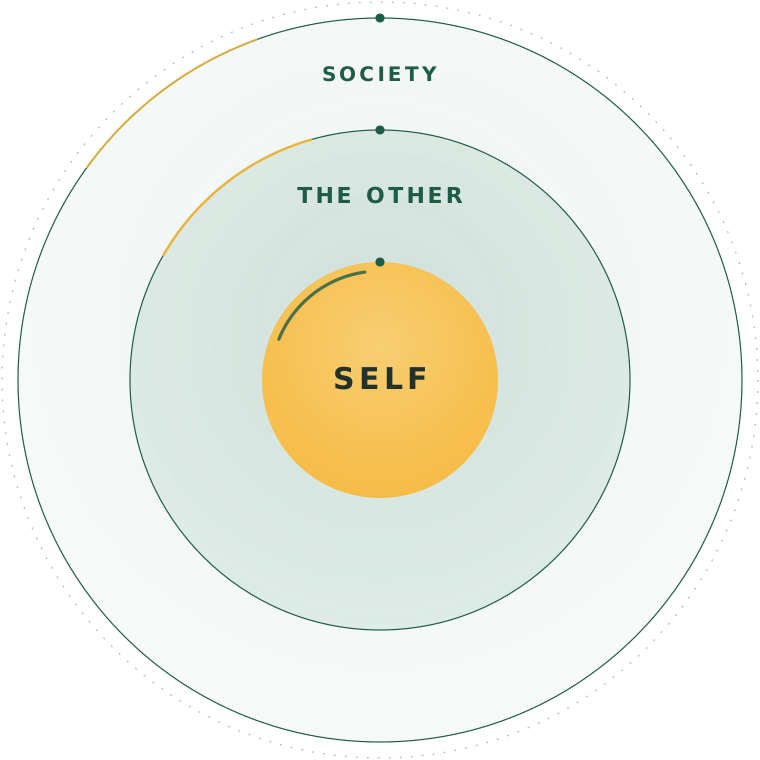
Four terms of ten weeks. Each one opens a new capability, and every term keeps practicing everything before it.
Children learn that feelings are visitors, that all of them are allowed, and that every one of them leaves. They collect their first precise words and learn the check in ritual that opens every lesson for the rest of the year.
Choosing between close words. Twin pairs that feel identical in the body, like excited and nervous. The size of a feeling. Two feelings at once. And at the end of the term, the first thing to do rather than only say.
Regulation, taught properly. What happens in the body, how long it actually lasts, and a personal set of things that work. Not one technique for everybody, a toolkit each child assembles for themselves.
Noticing other people. Asking instead of assuming. Saying what you observed, what you felt, what you needed, and what you would like. The first real steps of empathy, practiced rather than described.
Three stages, and the order matters because each one informs the next.
One term of ten weeks, in a small number of your centers and the age levels you choose. Your teachers get everything they need for that term, and the license fee for the pilot itself is waived. What we are testing is not whether the children enjoy it. They do. What we are testing is whether the numbers move in your setting.
Running alongside the pilot. Your teachers are trained and certified in person, and the card deck is redrawn to carry your own character instead of ours, so the materials in your classrooms are visibly yours.
After the term, the program extends to the centers you choose, on a per child license. That decision is made with the pilot results on the table, which is why the success criteria are agreed in writing before the pilot begins rather than after it.
What we would need from you is smaller than most people expect. One protected thirty minute slot a week in each participating class, local printing of the card decks from files we supply, one named person who owns the measurement dates, your teachers released for the training days, and your mascot artwork for the adaptation.
A teacher opens the lesson book to this week and teaches. Every line they say is written, including what to say when a child is shy, when a child shares something big, and when nobody wants to speak at all. Above each lesson there is a short note explaining why it matters, written to be read with coffee rather than studied, and it costs none of the class time.
Alongside the lessons there is a program guide that a teacher reads once before starting, a games library to swap from, a wall card of the three daily habits, and a short sheet that goes home with each child every week. Teachers are trained and certified by the person who wrote the program, so nobody is handed a folder and left to interpret it.
The full curriculum. One hundred and sixty lessons across four levels and four terms, for children aged around three to six, with the wordless deck and every game.
Ask, for every teacher. The app that answers her question in the moment and trains her through her first term.
Ask, for every family. Parent mode, so a parent can understand what her child is doing without being told what her child feels.
Founder led training, in your school, with your teachers, before the term begins.
The Feeling Words Checklist, run at three points in each term, comparing each child to her own earlier self.
Nothing is sold separately and nothing is gated behind a higher tier.
Teachers are trained over two days, or four half days, by the person who wrote the program. The training is built around practice rather than lecture: by the end of it every teacher has run a real check in, taught a feeling word in their own way, played the games, and completed a measurement round.
They then teach with provisional status while the program is running, and are certified after one observed lesson a few weeks in. The standard is about what a teacher can do rather than what they know, because a teacher who can recite the philosophy and cannot hold a check in has not learned the program. Certification names the teacher and the age level, and it is renewed rather than permanent.
Certification is a professional standard for teaching this program. It is not a qualification in psychology, counseling or therapy, and it does not represent one.
Every lesson at every level has the same five parts, in the same order, for the whole year. Children settle into the shape of it within three weeks, and teachers stop needing to think about structure at all.
A short note to the teacher explaining why this lesson matters and what to watch for. It is written to be read with coffee, not studied.
The class says the sentence the whole program rests on, and the youngest children wave the visitors goodbye.
The teacher goes first, with something true and small. Then the children, one word or two. Passing is always allowed, for children and for teachers.
One new word, one twin pair, or one strategy. Always the same method: the teacher shows their own version, then asks for each child's version.
In this program the games are the method, not the reward at the end.
The secret again, and three slow breaths together.
One short sheet goes home with each child. The word of the week, one thing to try, and one sentence a parent can use.
This is the vocabulary the program grows, and it is one wheel for every age. New words sit at the center, growing words in the middle, expert words at the edge. Children of every age start at the center and move outward at their own pace, so a class can hold a beginner and an expert at the same time without either of them being wrong.
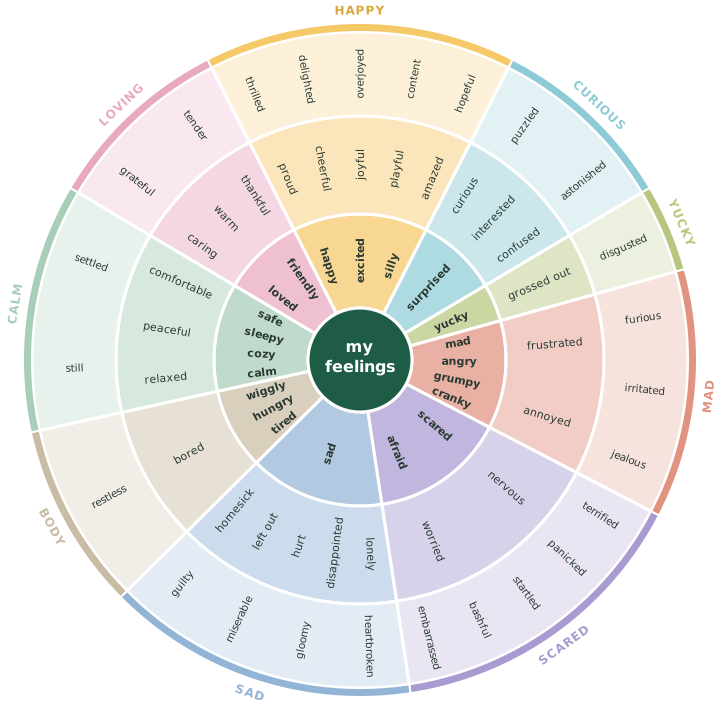
Center outward: New words, Growing words, Expert words, and beyond.
The wheel is what we teach, not where a child must stop. A precise feeling word from outside it, from a book, from home, from another language, counts as expert evidence and never as an error.
The deck holds twenty five illustrated feeling cards, and not one of them carries a label. That is the most deliberate decision in the whole program. Children decide for themselves what a card feels like, different readings of the same card are all correct, and no child is ever told their interpretation is wrong.
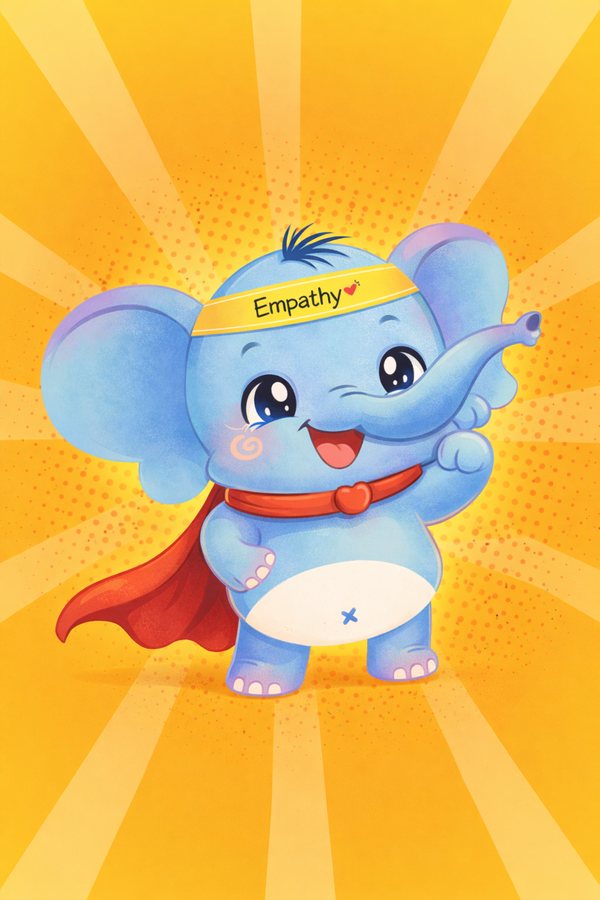

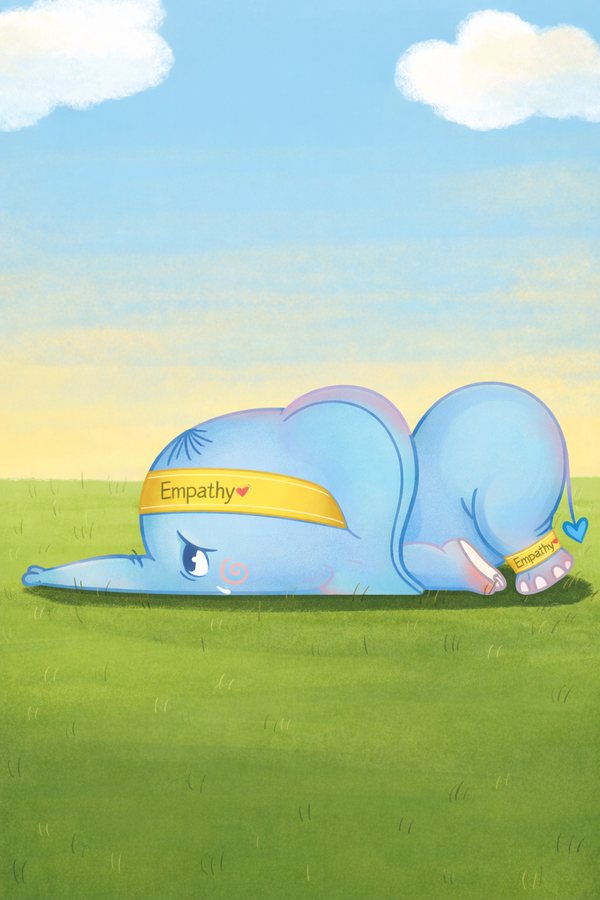


Partner editions of the deck carry the partner's own character rather than our elephants, and the card backs carry their brand. The illustrations stay open and unlabeled, because what makes each card work is how much room it leaves a child to decide.
We start with three cards rather than the whole deck, one warm, one hot and one deliberately ambiguous, and those are approved before the rest begin. From brief to print ready files takes about seven to nine weeks, and it runs alongside the pilot rather than delaying it. A pilot can start on our deck and switch when the partner edition is ready.
One thing never changes in an adapted deck: no words are added to any card, for any reason.




The same idea, four different characters.
A curriculum is mostly its rules. These are ours, and they appear in every lesson at every level.
The cards carry no word labels. Different readings of the same card are all correct, and no child is ever told their interpretation is wrong.
The only way to know what somebody feels is to ask them. Every guessing game closes the same way, by asking the person what they actually felt.
All feelings are allowed, always. What we teach is what to do while a feeling is here, so it can pass without anybody getting hurt.
Children move their own bodies and never anybody else's, and nothing that causes discomfort is ever offered as a way to cope. If a tool hurts, it is the wrong tool.
Every feeling is received exactly the same warm way, and passing is always allowed. The moment a child senses there is a right answer, the honesty stops.
A sorry a child does not mean teaches them to produce a word instead of noticing a person. Repair here means doing something about it.
This is a vocabulary and skills curriculum, not therapy, and teachers are not counselors. That boundary is written into the teacher guide rather than assumed, along with what to do if a child says something that worries an adult: the school's own child protection process comes first, immediately, ahead of anything in this program.
The measurement works the same way. It counts emotional vocabulary and nothing else. It is not a screening tool, it does not assess wellbeing, and it is never used to label a child.
Early years teams move, and children arrive in the middle of terms. A curriculum that only works with a stable roster is a curriculum that stops working in March, so this one is built around the reality instead.
A teacher who joins mid year completes a short onboarding, about ninety minutes, and can teach the following week with provisional status while they wait for the next full training. And every child is measured against their own first observation round rather than against the class, so a child who arrives in week six starts their own baseline in week six and their progress is still real. Nobody is behind. They are just at their own place on the wheel.
Weekly programs fail in week four, when the slot quietly becomes flexible. So partners get a short guide of their own covering the handful of decisions that actually determine the result: where the lesson sits in the timetable and how it is protected, how the daily habits stay visible between lessons, who owns the measurement and on which dates, and two rules that have to hold across the whole building rather than only in the classrooms running the lessons.
Thirty minutes a week of teaching, with everything already written, so preparation is close to zero. Between lessons it lives in three small habits that ride on routines a classroom already has. There is no marking, no planning, and no evening work.
A new teacher completes a short onboarding and teaches the following week, then joins the next full training for certification. The lessons are scripted precisely so that the program does not live only in one person's head.
They start where the class is, and they start their own measurement baseline in their own first week. Every lesson repeats the ritual and the core idea, so a class carries its own continuity and a new child is not behind anybody.
No physical products. You print the card decks locally from files we supply, at whatever scale suits you, and any print shop can do it. There is nothing to reorder and no consumables.
No. It is a vocabulary and skills curriculum, taught by teachers. Where a child needs more than a classroom can give, your own wellbeing and child protection process takes over, and the teacher guidance says so explicitly rather than leaving it assumed.
Then the numbers will say so, and you will see them at the same time we do. The criteria are agreed in writing before the term starts, your curriculum team reviews the raw records alongside us, and a pilot that misses its numbers is information rather than an argument.